
If you’ve ever shopped on Amazon, subscribed to Netflix, purchased skincare directly from a brand, or heard about companies building software for governments, you’ve already interacted with different business models.
Every successful company follows a business model that defines who it sells to, how it delivers value, and how it generates revenue.
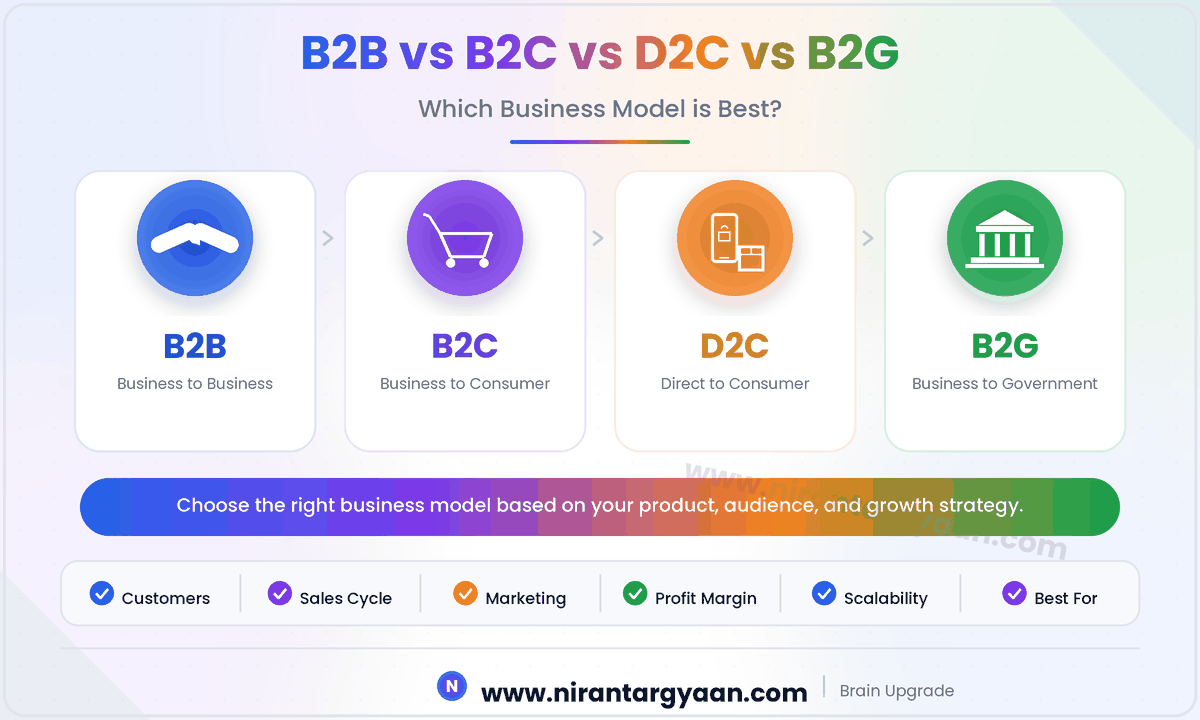
The four most common business models are the following:
- B2B (Business-to-Business)
- B2C (Business-to-Consumer)
- D2C (Direct-to-Consumer)
- B2G (Business-to-Government)
Understanding these models is essential for entrepreneurs, students, marketers, and business owners because choosing the right model directly impacts marketing, sales, customer relationships, and profitability.
Table of Contents
ToggleWhat Is a Business Model?
A business model is the strategy a company uses to create value, deliver products or services, and earn money.
Think of it as the blueprint that answers four important questions:
- Who is the customer?
- What value does the business offer?
- How does it reach customers?
- How does it make money?
For example, a clothing brand may sell directly to consumers through its website (D2C), while a software company may sell enterprise solutions to corporations (B2B).
Choosing the right business model is one of the most important decisions any company makes.
What Is B2C (Business-to-Consumer)?
The B2C (Business-to-Consumer) model is the most familiar type of business. Here, a company sells products or services directly to individual consumers who use them personally rather than reselling them.
How B2C Works
Imagine you need a new pair of running shoes. You visit Nike’s website, choose your size, make the payment, and receive the shoes at home. The transaction happens directly between the business and the consumer.
This is B2C.
Examples of B2C Businesses
- Amazon
- Nike
- Netflix
- Flipkart
- Zomato
Characteristics
- Large customer base
- Fast purchasing decisions
- Emotional buying behavior
- Lower average order value
- Heavy focus on branding and advertising
Advantages
- Massive market potential
- Faster sales cycle
- Easier to scale through digital marketing
- Strong brand recognition
Disadvantages
- High competition
- Rising advertising costs
- Lower customer loyalty if experience is poor
Realistic Case Study: Nike
Nike has built one of the world’s strongest B2C brands by combining product innovation with storytelling. Instead of simply selling shoes, Nike sells motivation, performance, and lifestyle. Its campaigns featuring athletes inspire customers emotionally, while its mobile app and
Loyalty programmes encourage repeat purchases. This customer-first approach has helped Nike maintain a loyal global audience despite intense competition.
What Is B2B (Business-to-Business)?
In the B2B (Business-to-Business) model, one business sells products or services to another business instead of individual consumers.
How B2B Works
A manufacturing company needs accounting software to manage finances. Instead of developing its own software, it purchases a subscription from a software company like Salesforce or Microsoft.
This transaction is B2B because the customer is another business.
Examples
- Salesforce
- Microsoft Enterprise
- Oracle
- SAP
- Intel
Characteristics
Higher-order values
- Long sales cycles
- Multiple decision-makers
- Contract-based relationships
- Focus on ROI (Return on Investment)
Advantages
- Higher revenue per customer
- Long-term contracts
- Stable recurring income
- Strong business relationships
Disadvantages
- Longer negotiation process
- Complex sales process
- Requires trust and credibility
Realistic Case Study: Salesforce
Salesforce provides CRM software that helps businesses manage customer relationships. A mid-sized company may spend thousands of dollars annually on Salesforce because the software improves productivity, customer service, and sales performance. Before purchasing, decision-makers from IT, finance, and management evaluate the product, making the sales cycle longer than in B2C.
What Is D2C (Direct-to-Consumer)?
The D2C (Direct-to-Consumer) model allows brands to sell products directly to customers without using wholesalers or retailers.
This gives brands greater control over pricing, customer experience, and marketing.
How D2C Works
A skincare company manufactures its own products and sells them through its website and mobile app instead of relying only on supermarkets or retail stores.
Customers interact directly with the brand, making communication and support more personal.
Examples
- Mamaearth
- boAt
- Dell Technologies
- Sugar Cosmetics
- The Whole Truth Foods
Characteristics
- No middlemen
- Higher profit margins
- Ownership of customer data
- Personalized marketing
- Strong online presence
Advantages
- Better customer relationships
- More control over branding
- Higher profitability
- Faster customer feedback
Disadvantages
- High customer acquisition costs
- Logistics management
- Inventory responsibility
Realistic Case Study: Mamaearth
Mamaearth began by selling products online directly to customers. By collecting customer reviews and purchase data, the company improved product quality and launched targeted marketing campaigns. This direct connection with consumers helped the brand grow rapidly while maintaining strong customer loyalty.
What Is B2G (Business-to-Government)?
The B2G (Business-to-Government) model involves businesses supplying products or services to government organisations through contracts, tenders, or procurement systems.
How B2G Works
A government department needs software to digitise citizen services. It publishes a tender inviting companies to submit proposals. After evaluating technical expertise, pricing, and compliance, the government awards the contract to the most suitable company.
Examples
- Tata Consultancy Services (TCS)
- Infosys
- Larsen & Toubro
- Bharat Electronics Limited
Characteristics
- High-value contracts
- Formal procurement process
- Strict compliance
- Long approval cycles
- Stable business opportunities
Advantages
- Large project values
- Long-term contracts
- High credibility
- Predictable revenue
Disadvantages
- Lengthy tender process
- Extensive documentation
- Competitive bidding
Realistic Case Study: Infosys
Infosys has developed digital platforms for government agencies, including citizen service portals and administrative systems. These projects often span several years and require strict compliance with government standards. Successful delivery strengthens the company’s reputation and opens opportunities for additional contracts.
Key Differences Between B2B, B2C, D2C, and B2G
Feature | B2C | B2B | D2C | B2G |
Customer | Individual | Business | Consumer | Government |
Sales Cycle | Short | Medium to Long | Short | Long |
Order Value | Low to Medium | High | Medium | Very High |
Marketing Focus | Branding | Relationship Building | Customer Experience | Tenders & Compliance |
Decision Making | Individual | Multiple Stakeholders | Individual | Government Officials |
Marketing Strategies for Each Model
B2C Marketing
Successful B2C businesses focus on the following:
- Social media marketing
- Influencer collaborations
- Paid advertising
- Emotional storytelling
- Discounts and promotions
B2B Marketing
B2B businesses rely on the following:
- LinkedIn marketing
- Content marketing
- SEO
- Email campaigns
- Product demonstrations
- Webinars
D2C Marketing
D2C brands prioritize:
- Search engine optimization
- Personalized email marketing
- Loyalty programs
- Social commerce
- Customer reviews
B2G Marketing
B2G companies focus on:
- Government tenders
- Compliance certifications
- Technical proposals
- Industry networking
- Public procurement platforms
Which Business Model Should You Choose?
The right business model depends on your goals:
- Choose B2C if you want to sell directly to everyday consumers.
- Choose B2B if your product solves business problems.
- Choose D2C if you manufacture your own products and want full control over the customer experience.
- Choose B2G if you have the expertise to meet government procurement requirements and manage large projects.
Some companies combine multiple models to diversify revenue and reduce risk.
Common Mistakes Businesses Make
Many businesses struggle because they apply the wrong strategy for their business model.
Common mistakes include:
- Using emotional consumer advertising for B2B products.
- Ignoring customer feedback in D2C businesses.
- Expecting government contracts to close quickly.
- Underestimating the importance of long-term relationships in B2B sales.
Avoiding these mistakes can improve customer satisfaction and long-term growth.
Future Trends
Business models continue to evolve with technology.
Key trends include:
- AI-powered customer support
- Personalized shopping experiences
- Omnichannel sales strategies
- Government digital transformation
- Increased use of automation and analytics
- Sustainable business practices
Companies that embrace these trends are more likely to remain competitive.
Frequently Asked Questions (FAQs)
Q1. What is the biggest difference between B2B and B2C?
B2B sells to businesses, while B2C sells directly to individual consumers.
Q2. Is D2C the same as B2C?
No. D2C is a type of B2C where the brand sells directly to consumers without intermediaries.
Q3. What is a B2G business?
A B2G business provides products or services to government organizations through contracts or tenders.
Q4. Can one company use multiple business models?
Yes. Many companies, such as Amazon and Nike, operate across multiple business models.
Q5. Which business model is most profitable?
Profitability depends on the industry, product, and execution. B2B and B2G often generate higher-value contracts, while D2C can achieve higher margins by eliminating intermediaries.
Conclusion
Understanding the differences between B2B, B2C, D2C, and B2G is essential for building a successful business. Each model serves a different audience, follows a different sales process, and requires a unique marketing strategy.
Whether you’re launching a startup, expanding an existing business, or learning about commerce, choosing the right business model will influence your growth, profitability, and customer relationships. By studying real-world examples and adapting proven strategies, you can create a business that delivers value to the right audience and remains competitive in an evolving marketplace.








Leave a Reply
You must be logged in to post a comment.