
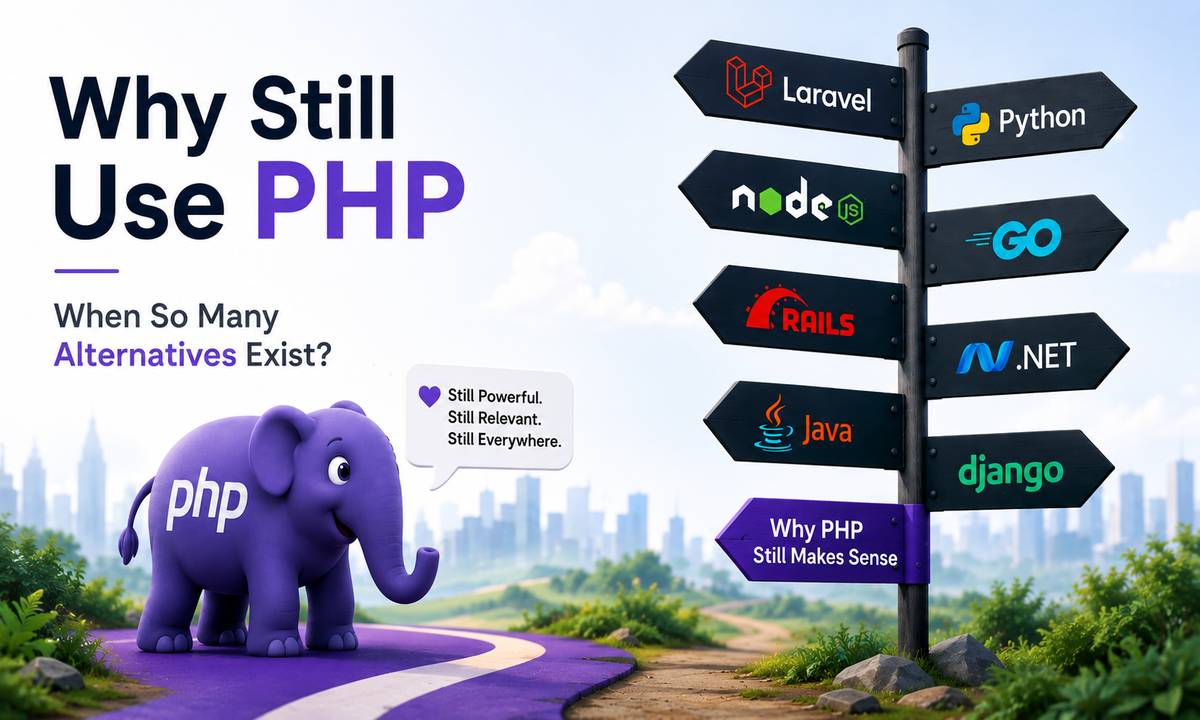
Discover why PHP is still one of the most popular backend programming languages in 2026. Learn about PHP performance, security, frameworks, career opportunities, comparisons with Python and Node.js, and why millions of websites continue to rely on PHP.
Table of Contents
ToggleIntroduction
Every few years, a new programming language emerges and is hailed as the future of web development. Developers have seen the rise of Python for artificial intelligence, Node.js for real-time applications, Go for cloud-native services, and Rust for systems programming. As a result, one question appears repeatedly in developer communities:
“Why still use PHP when so many alternatives exist?”
At first glance, the question seems reasonable. After all, the technology landscape has changed dramatically over the past decade. Businesses demand faster applications, developers seek better tooling, and startups often experiment with newer programming languages.
Yet despite all this competition, PHP continues to power millions of websites and remains one of the most widely used server-side programming languages in the world. It has evolved far beyond its early reputation, offering significant improvements in performance, security, maintainability, and developer experience.
In this guide, you’ll discover why PHP remains relevant in 2026, how it compares with modern alternatives, and whether it is still the right language for your next project or career.
What Is PHP?
PHP (Hypertext Preprocessor) is an open-source, server-side scripting language designed primarily for web development. It executes on the server, processes requests, interacts with databases, and generates dynamic HTML that is sent to the user’s browser.
Unlike frontend languages such as HTML, CSS, and JavaScript, PHP runs behind the scenes. It handles tasks such as the following:
- User authentication
- Form processing
- Database operations
- Content management
- Session handling
- API development
- File uploads
- E-commerce functionality
Because PHP integrates seamlessly with HTML and supports multiple database systems, it remains one of the easiest backend languages to deploy and maintain.
The Evolution of PHP
Many people judge PHP based on how it looked 10 or 15 years ago. That is a mistake.
Modern PHP has undergone significant improvements, transforming it into a mature and capable language.
Major improvements include:
- Strong typing support
- Anonymous functions
- Namespaces
- Traits
- Composer dependency management
- Modern object-oriented programming
- Attributes (annotations)
- JIT compilation
- Better error handling
- Improved security features
- Faster execution engine
Today’s PHP is far more modern than the version many developers first encountered.
Why People Think PHP Is Dying
The belief that PHP is “dead” comes from several misconceptions.
Legacy Code
Many older websites still run outdated PHP versions, leading developers to associate PHP with poor coding practices.
New Languages Receive More Attention
Languages like Go, Rust, and Python receive significant media attention because they power modern technologies such as cloud computing, artificial intelligence, and blockchain.
Social Media Trends
Programming discussions on social media often favor newer technologies, creating the impression that older languages are obsolete.
However, popularity on social media does not necessarily reflect real-world industry demand.
Why PHP Continues to Thrive
Despite criticism, PHP remains one of the most successful web programming languages ever created.
Let’s examine why.
1. PHP Powers Millions of Websites
One of PHP’s greatest strengths is its enormous adoption.
A significant portion of the web still relies on PHP-based platforms and applications.
Businesses continue investing in PHP because replacing an existing, stable infrastructure with another language is often expensive, risky, and unnecessary.
Industries using PHP include:
- E-commerce
- Education
- Healthcare
- Government
- Finance
- News websites
- Entertainment
- SaaS platforms
- Corporate websites
This extensive adoption creates consistent demand for PHP developers.
2. WordPress Keeps PHP Extremely Relevant
If you have ever visited a blog, company website, or online magazine, chances are it was built using WordPress.
Since WordPress is written in PHP, millions of websites depend on PHP for daily operation.
PHP developers build:
- Custom themes
- Plugins
- Membership systems
- WooCommerce stores
- SEO tools
- Learning management systems
- Booking systems
Because businesses continue investing in WordPress, PHP remains one of the most valuable programming skills for freelancers and agencies.
3. Laravel Has Revolutionized PHP Development
One reason PHP remains competitive is Laravel.
Laravel transformed PHP development by introducing elegant syntax, clean architecture, and powerful built-in features.
Laravel includes:
- Authentication
- Routing
- Database ORM (Eloquent)
- Queues
- API resources
- Task scheduling
- Testing tools
- Caching
- Mail services
- Security features
Many developers who once criticized PHP changed their opinion after working with Laravel.
4. Excellent Performance
Older PHP versions had performance limitations.
Modern PHP is significantly faster.
Recent improvements include the following:
- Optimized Zend Engine
- Lower memory consumption
- Better caching
- Improved opcode execution
- JIT compiler for specific workloads
For traditional web applications, PHP delivers excellent speed while requiring relatively modest server resources.
A well-optimized PHP application can comfortably support thousands of concurrent users when combined with proper caching, database optimization, and efficient infrastructure
5. Easy Learning Curve
Compared with many backend languages, PHP is beginner-friendly.
New developers can quickly understand the following:
- Variables
- Loops
- Functions
- Arrays
- Forms
- Sessions
- Cookies
- Database queries
Because PHP can be embedded directly within HTML, beginners often find it easier to understand how server-side programming works.
PHP vs Python: Which Is Better?
One of the most common questions among beginners is whether to learn PHP or Python. Both are powerful programming languages, but they serve different purposes.
Feature | PHP | Python |
Primary Use | Web Development | AI, Data Science, Automation, Web |
Learning Curve | Easy | Easy |
Performance | Excellent for Web | Good |
AI & Machine Learning | Limited | Excellent |
CMS Support | Excellent | Limited |
Hosting | Widely Available | Available but less common |
Choose PHP If You Want To:
- Build websites
- Develop WordPress plugins or themes
- Create eCommerce stores
- Build REST APIs
- Become a freelance web developer
Choose Python If You Want To:
- Work in artificial intelligence
- Build machine learning models
- Perform data analysis
- Automate repetitive tasks
- Enter scientific computing
Verdict: PHP remains a stronger choice for traditional web development, while Python dominates AI and data science.
PHP vs. Node.js
Node.js allows developers to use JavaScript on the server, making it popular for real-time applications.
PHP Advantages
- Simpler deployment
- Mature ecosystem
- Excellent CMS support
- Lower hosting costs
- Large talent pool
Node.js Advantages
- Real-time applications
- WebSockets
- High concurrency
- Full-stack JavaScript development
Best Use Cases
PHP
- Business websites
- Blogs
- CMS platforms
- Online stores
- Corporate portals
Node.js
- Chat applications
- Live collaboration tools
- Streaming platforms
- Gaming servers
- Real-time dashboards
PHP vs Java
Java is widely used for enterprise applications.
Java Excels In
- Banking
- Insurance
- Enterprise software
- Android development (historically)
- Large distributed systems
PHP Excels In
- Rapid web development
- Content management
- Startup MVPs
- Freelancing
- Website development
Java projects often require more setup, while PHP enables quicker development cycles.
PHP vs Rust
Rust is praised for safety and performance.
Rust is ideal for:
- Operating systems
- Embedded software
- High-performance systems
- Security-critical applications
PHP is ideal for:
- Websites
- APIs
- CMS development
- Web portals
- E-commerce
Rust and PHP solve different problems rather than directly competing.
Why Businesses Continue Using PHP
Businesses rarely choose technology based on trends alone. They prioritize stability, cost, maintainability, and available talent.
PHP offers:
- Proven reliability
- Long-term support
- Large developer community
- Extensive documentation
- Affordable hosting
- Fast development
These factors reduce project costs and make PHP a practical choice for many organizations.
Case Study 1: WordPress Ecosystem
Imagine a digital marketing agency building websites for small businesses.
The agency needs:
- Fast development
- SEO-friendly websites
- Blogging capabilities
- E-commerce integration
- Affordable hosting
Using PHP with WordPress allows the agency to deliver projects quickly while keeping costs manageable.
This is one reason PHP remains popular among agencies and freelancers.
Case Study 2: Laravel SaaS Startup
A startup wants to launch a software-as-a-service (SaaS) platform.
Requirements include:
- User authentication
- Payment integration
- Email notifications
- API support
- Admin dashboard
Laravel provides these features through its built-in ecosystem, allowing developers to focus on business logic instead of building everything from scratch.
Career Opportunities for PHP Developers
Despite frequent claims that PHP is declining, skilled PHP developers remain in demand.
Common roles include:
- PHP Developer
- Laravel Developer
- WordPress Developer
- Backend Engineer
- Full-Stack Developer
- API Developer
- Software Engineer
- Web Application Developer
Many businesses also hire PHP developers to modernize legacy systems, migrate applications, and improve performance.
Is PHP Future-Proof?
PHP continues to receive active development, regular performance improvements, security updates, and language enhancements. Modern frameworks and tools keep the ecosystem competitive, and the massive number of existing PHP applications ensures ongoing demand for developers who can build, maintain, and modernize them.
While no programming language is guaranteed to dominate forever, PHP has demonstrated remarkable longevity by evolving alongside the web.
Common Myths About PHP
Myth 1: PHP Is Dead
This is probably the most common myth.
Reality:
PHP continues to power millions of websites and remains one of the most widely deployed backend languages.
Myth 2: PHP Is Slow
Older PHP versions had performance issues.
Modern PHP versions are significantly faster thanks to:
- Zend Engine improvements
- Opcode caching
- Better memory optimization
- JIT compilation for certain workloads
Performance now depends more on application design, database optimization, and server configuration than on the language itself.
Myth 3: PHP Is Insecure
A language itself is not inherently secure or insecure.
Most security problems arise from poor coding practices.
Modern PHP provides tools to help prevent:
- SQL Injection (using prepared statements)
- Cross-Site Scripting (XSS)
- Cross-Site Request Forgery (CSRF)
- Password storage vulnerabilities (with password hashing APIs)
Secure applications require secure development practices, regardless of the language used.
Myth 4: PHP Can’t Build Large Applications
Many large-scale web applications and enterprise systems have been built with PHP over the years.
Modern frameworks support modular architecture, testing, dependency management, and scalable deployment, making PHP suitable for projects of various sizes.
Key Takeaways
- PHP continues to be actively developed.
- Modern PHP is significantly faster and more secure than older versions.
- Laravel and Symfony provide excellent developer productivity.
- PHP remains one of the easiest backend languages to deploy.
- A large installed base creates ongoing demand for PHP developers.
- Learning PHP alongside HTML, CSS, JavaScript, SQL, and Git provides a strong foundation for web development.
Frequently Asked Questions (FAQs)
1. Is PHP still worth learning in 2026?
Yes. PHP remains widely used for web development, content management systems, APIs, and business applications.
2. Is PHP better than Python?
Neither language is universally better. PHP excels in web development, while Python is stronger for AI, automation, and data science.
3. Is Laravel better than plain PHP?
Laravel provides structure, security features, routing, authentication, and many built-in tools that simplify development. Plain PHP is suitable for smaller or simpler projects.
4. Can PHP build REST APIs?
Yes. PHP supports REST API development, and frameworks like Laravel and Symfony include robust API features.
5. Is PHP suitable for beginners?
Yes. PHP has a straightforward syntax, extensive documentation, and a large community, making it accessible to new developers.
6. Does PHP have good job opportunities?
Yes. Many companies, agencies, and freelancers continue to use PHP for maintaining and developing websites and web applications.
7. Which PHP framework should I learn first?
Laravel is a popular starting point due to its modern syntax, rich ecosystem, and comprehensive documentation.
Final Verdict
So, why still use PHP when so many alternatives exist?
Because PHP continues to solve real-world problems efficiently.
It offers:
- Fast web development
- Mature frameworks
- Affordable hosting
- Excellent documentation
- Strong community support
- A huge ecosystem
- Millions of existing applications
- Consistent language improvements
Newer languages have their own strengths, and they are excellent choices for specific domains. However, for traditional web development, content management systems, business websites, and many web applications, PHP remains a dependable and cost-effective solution.
Rather than asking whether PHP is “dead,” the better question is whether it meets your project’s needs. In many cases, the answer is still yes.








Leave a Reply
You must be logged in to post a comment.